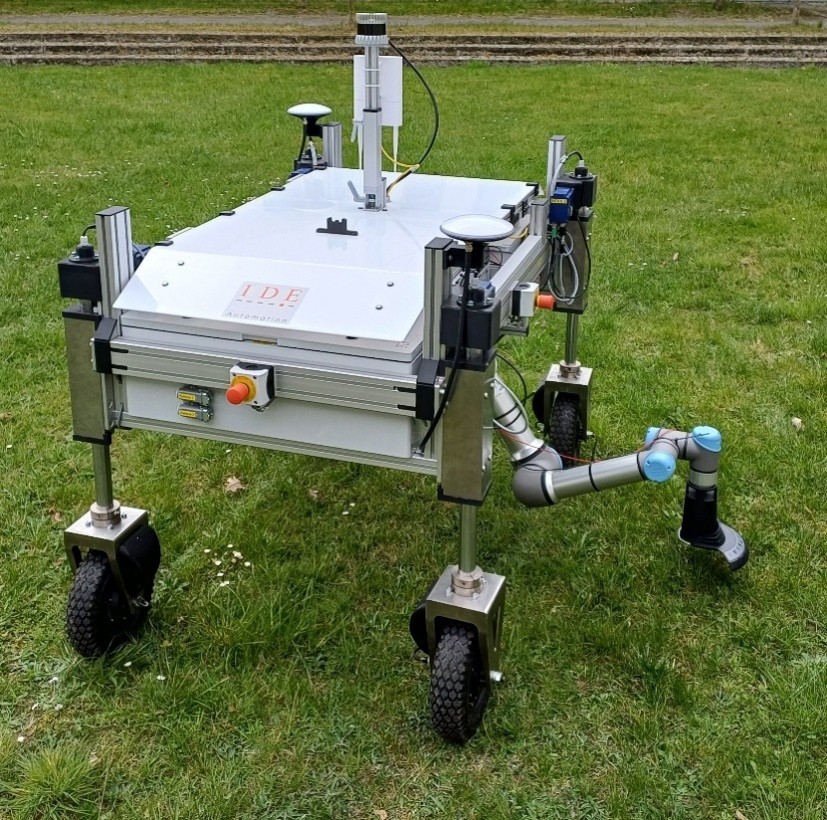
The paper, authored by Dr. Volker Saggau, Moritz Gerwin and Prof. Floris Ernst, presents a novel approach for planning and simulating field-robot deployments on digital pastures.
Recognising the limited use of robots in grazing systems, the authors develop a digital twin that communicates bidirectionally with a mobile field robot. This connection enables operators to define precise work areas, prioritize tasks and adjust plans by combining global cadastral map data with live sensor streams from the robot.
Key functionalities demonstrated include systematic area exploration, automated vegetation classification and semi-autonomous fence clearing. Safety mechanisms are embedded, such as stop-rules that activate when protected animals or nest structures are detected, ensuring ecological compliance. The map-based user interface allows spatial delineation of zones and sequencing of operations, while the integration of local robot autonomy supports adaptive control in varying terrain conditions.
To facilitate training, stakeholder communication and participatory planning, the system incorporates the Landwirtschaftssimulator from GIANTS Software. This 3-D simulation environment offers an intuitive, photorealistic view of the pasture, surpassing traditional GIS tools and robot-specific simulators in usability and visual fidelity.
Preliminary tests on the prototype have confirmed reliable data exchange between robot and twin, successful navigation across heterogeneous ground, and detection of plant species such as Rumex. Although the user interface is still in an early development stage, the results highlight the concept’s feasibility and its potential to bring digital tools into practical pasture livestock management. Ongoing work will focus on advanced sensor data processing, enhanced safety protocols, and broader user involvement to refine the system.
The contribution has been accepted for an upcoming presentation at GIL 2026, underscoring its relevance to the agricultural robotics community.